
 By
By XDC Network Co-Founder Atul Khekade believes blockchain’s future will depend less on proving that the technology works and more on solving the harder challenge: getting governments, enterprises and everyday users to adopt it.
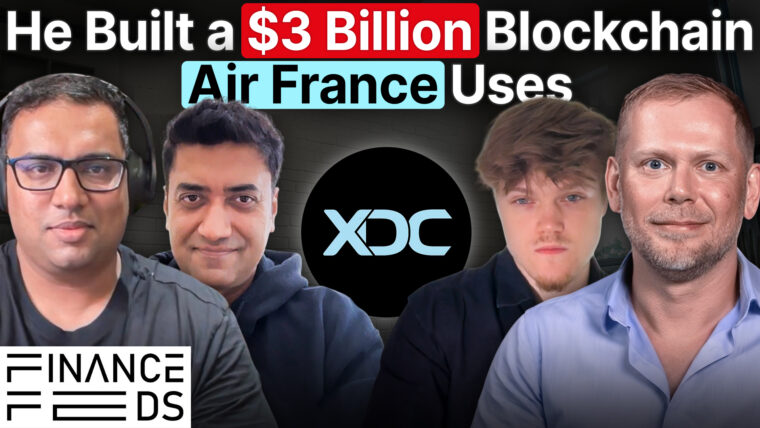
Speaking on the latest FinanceFeeds Podcast with FinanceFeeds Editor-in-Chief Nikolai Isayev and host Ivan Patriki, Khekade discussed the origins of XDC, the network’s focus on trade finance and tokenization, the slow pace of blockchain adoption, regulatory alignment, artificial intelligence and the lessons he learned after years of building in crypto.
The conversation began with Patriki asking Khekade how XDC started and what the original vision behind the network was.
Khekade explained that XDC was born from a problem he encountered while working on cross-border finance and payments: the lack of a common trust layer connecting different parties across international markets.
“I think the whole concept in the mind started around 2015, 2016. This was when me and Nutesh were also involved with a lot of cross-border trade finance and payment transactions, like financing heavy machinery, financing airplanes, financing cross-border debt between participants, and one thing was very clear that there was no cross-border platform for cross-border trust. You basically just had to work with either one bank which had that kind of global presence. Even then, it was very difficult just to move money and to be able to come with terms that could be agreed by all parties.”
Khekade said Bitcoin introduced the idea of a shared settlement layer, but Ethereum expanded the possibilities by showing that blockchain could support more complex agreements.
“When Bitcoin came in the picture, that was a very clear use case. You have a layer that everyone can work with. You can have just one escrow, and you can work with it more easily. But then it was Ethereum that really opened our eyes, thinking that, look, there’s so much you can do more.”
However, after experimenting with existing blockchain infrastructure, Khekade said his team concluded that the technology was not yet designed for enterprise-level applications.
“The more we used it, we were like, no, this is not still enterprise level. You’ll have to change consensus. You’ll have to have certain modifications in the virtual machine to make it enterprise.”
That realization pushed the team to build a network focused specifically on institutional use cases, with the ambition of creating infrastructure that could support international commerce.
“The whole concept was that you could have a single trust network for settlements, escrow, recording agreements, basically a trust layer for international commerce, which is like a huge field in itself.”
Khekade explained that traditional international trade remained inefficient because agreements, documentation and settlement often existed in separate systems.
“Whatever even SWIFT does, settlement is not part of the mainstream agreements, and the agreement itself happened in a very conventional, paper-based way. It was something that no one could do very quickly. Trade settlements and the entire trade cycle took months to happen, even if two parties agreed and they wanted to do it.”
The solution, he said, was creating infrastructure that could combine smart contracts with faster settlement processes.
“The whole concept of having smart contracts, having real-time settlement was so appealing and worth putting all effort. Our first effort back then was designing a network that could firstly handle that scale that enterprises could trust.”
Building XDC Around Institutional Participation
After hearing the background behind XDC’s creation, Patriki continued by asking how the network moved from an idea into an ecosystem capable of attracting institutions and partners.
Khekade explained that enterprise participation was part of the network design from the beginning, including the way validators would be selected and operate.
“We started with a few things. We were one of the first ones to think KYC at node level. If you have to be a network validator processing transactions, you have to have KYC attached to your node.”
He said XDC wanted financial institutions to participate without creating a system where only the largest holders could dominate the network.
“The way architecture was combined was made it easier for any corresponding banks, financial institutions to participate. So you have basically 10 million XDCs that you can stake, and you can become a validator yourself. It was not a pure POS where you just take as many as possible. It was meant to create a very clear level playing field for all institutions to come in and be able to set up networks.”
Khekade added that even larger holders would not automatically gain additional influence under the model.
“It was like 10 million minimum, and that’s it. Even if you had more, it didn’t matter. You were part of the same level on the consensus framework, which is what we got great feedback on — that you created a same-level, equal kind of participating field for institutions to join.”
XDC began working on early proof-of-concept projects around 2016, launched an initial testnet in 2017 and moved to a full-scale network in 2019.
Khekade said some of the earliest applications involved trade settlement, aviation-related processes and supply-chain activity.
“Some of the very early transactions were like cross-border settlement, trade lifecycle between aircraft, their maintenance, their parts. A project we did for Ramco, Air France, KLM, other airlines, some supply-chain projects. So we started from there, and then we realized that, look, it’s much more than what we’re building.”
From Early Crypto Community to Institutional Adoption
After explaining the technical foundation behind XDC, Khekade described how the network attracted its first participants and gradually expanded beyond its initial trade-finance focus.
Patriki asked how XDC managed to build relationships with major companies and institutions, noting that these partnerships do not simply appear without an existing network.
Khekade explained that many of those relationships came from his team’s previous business experience, but the early XDC community also played a major role in expanding the project’s reach.
“We are people who built businesses big by big before we came up with those connections. A lot of those ourselves, like the Air France-KLM-Ramco connection was there. We have publicly done a lot of projects for major companies, and then I think the rest of it, that was the initial part of it.”
“When we had that early community that came in, I think that was very instrumental in taking us to the next level. So they are the ones who really helped us get our voices and the whole concept out on whether it was Twitter, LinkedIn. Then some of them came in as our early business development guys who made all that reach out, and gradually over the period of these 10 years, we now have a steady flow of corporate partners who come our way.”
Khekade said the introduction of the XDC token also helped attract a different type of participant — people already working inside large financial organizations who saw potential in blockchain but were not yet ready to publicly associate themselves with the industry.
“The demand came in when we introduced token. There were people, high-net-worth individuals who were working in big positions in big corporates, and they thought, look, at this time maybe we’ll come and join as well later, and when this becomes very mainstream in the future, we can bring in the companies that we are leading.”
He explained that many early participants were not traditional retail users despite appearing as such from the outside.
“We had various registrations like trade trust, the whole Commonwealth framework for agreeing between parties on a document and workflows. We were one of the first ones to implement that. Then came USDC on the chain, various projects, DeFi, all that has been.”
Khekade said the broader infrastructure created around XDC eventually became the foundation for newer applications, including the network’s work around AI.
“It’s such a base level that we created. We realized that was so nice. People loved it so much.”
He explained that enterprises began looking at the combination of blockchain and AI as a potential next step.
“Only until recent times, one or two years ago, everyone was like, ‘Look, AI, and we would do this if AI and blockchain was like a perfect symmetry, and if they were working together.’ There are so many things that we don’t otherwise have any systems to work with, and XDC can do it so well for us.”
That thinking eventually led to the development of XDC AI.
Before XDC: Atul Khekade’s Entrepreneurial Journey
Before moving deeper into blockchain adoption, Patriki asked Khekade about his earlier career and the moment when he moved away from a traditional professional path toward entrepreneurship.
Khekade said the shift happened almost two decades earlier while he was working with Oracle following its acquisition of banking technology company i-flex Solutions.
“In 2005, I was working with Oracle for a company that they acquired called i-flex Solutions in Asia Pacific, which was doing original products for banking. While it was acquired, I was invited to work at the Oracle HQ, where I worked for some time.”
He said spending time in Silicon Valley changed his perspective on what was possible.
“I just looked at the Valley and the entire Bay Area, and I saw the whole entrepreneurship there, and I thought, look, you can do so much more. So I quit my job.”
Khekade then launched a program called Innovation Trip, which brought executives and CEOs from major companies into the US innovation ecosystem.
“The mission was to get major Fortune 500 executives and CEOs from outside of the US into the US innovation culture in Silicon Valley and Boston, and to get them together to kind of work on a framework of technology.”
The program focused less on individual products and more on understanding the process behind successful innovation.
“It was not the product itself, but the process of creating products, technology products that would transform industries. How you design it, how you actually get to see the customers that are using your products and how do you actually innovate from that.”
The business became successful enough that Khekade reached millionaire status at a very young age.
When Patriki asked how old he was at the time, Khekade answered:
“23.”
He also recalled being featured by BusinessWeek as one of Asia’s young entrepreneurs.
“I was actually featured by Bloomberg BusinessWeek as one of Asia’s most whatever, top 25 business guys, entrepreneurs under 25 something.”
However, Khekade said those early successes were not ultimately what pushed him toward blockchain.
He continued building companies and selling some of them, but said Bitcoin represented something different.
“By the time, I think 2013, 2014, 2015, I finally saw that maturity. When I saw Bitcoin, the whole vision, I could understand it, and then I thought, now this is the time to go for it.”
The motivation, he said, became less about personal wealth and more about creating something with global impact.
“You have to make something global, billions, trillions, whatever. I think it’s not about the money, but it’s about making a global impact that you really make something that everyone can use.”
Why Blockchain Adoption Has Been Slower Than Expected
After hearing Khekade’s background and the story behind XDC, FinanceFeeds Editor-in-Chief Nikolai Isayev shifted the conversation toward a broader industry question: why has blockchain adoption taken longer than many expected?
Isayev pointed out that XDC had been discussing tokenization and trade finance for years, and many of the concepts that were once considered early ideas are now becoming part of mainstream financial discussions.
However, he questioned whether adoption was moving quickly enough given the pace of technological development.
Khekade responded by focusing on a lesson he said became increasingly clear to him over recent years: building technology is only one part of creating a successful company.
“I heard someone speak, I don’t know who exactly it is. They say product is king, distribution is God.”
Khekade argued that some of the world’s most successful technology companies did not win only because they created innovative products, but because they mastered distribution.
“If you’ve seen really, really successful entrepreneurs, it’s Steve Jobs or Bill Gates. I think more than the product, which they came up with was nice to do, but there would have been other people who came up with the product. It was the distribution.”
The key question, he said, is not simply whether a technology works.
“How do you make it household? How do you get it there in every house?”
Khekade said this was one of the biggest lessons he learned while watching blockchain develop.
“You need that skill. It’s not just building products that you know people find interesting, but how do you get this technology to the people?”
He argued that technologies that reach mass adoption usually succeed because they align with broader economic and political structures.
“If you want to take those products household, and that’s where I think the whole story of tokenization and crypto kind of took a suffering and backstep, because the moment you have those concepts and ideas and you partner with governments across the world, you create a distribution power.”
Khekade compared blockchain’s situation with other technologies that became globally successful because they worked within existing systems.
“You have to be there. You can’t launch those products, no matter how good they are, without aligning with nations’ interests, law of the land, your defense policies, policies of the government.”
Khekade also argued that trying to bypass regulators and governments ultimately created unnecessary resistance.
“It’s completely bullshit what other people in this industry have tried to do, try to work around that and not create a distribution power that’s in interest of the governments.”
Instead, he believes blockchain companies need to focus on building systems that policymakers and institutions can support.
“I want to change that. I think you have to go, comply with laws of the land. You have to be really important at government level because that’s where your system is operating from.”
Stablecoins and Tokenization Already Have Real Demand
Khekade said that the issue is not whether people need blockchain-based financial tools.
In his view, the demand already exists.
“Most importantly, it’s not the growth that’s been held by people as such. There’s immense, immense potential from the actual people.”
He pointed specifically to stablecoins as one of the clearest examples of blockchain’s practical value.
“Today, you see stablecoin transfers. It’s really the best use case. You can move money from across the world in like seconds and settle it.”
The same applies to tokenization, according to Khekade.
“Today, the advantages of tokenization are immense. The advantages of using stablecoins are immense.”
He highlighted potential applications ranging from digital land records to around-the-clock financial markets.
“If you have app-based land records or a share or 24/7 trading or access to a debt instrument where you can say have overnight kind of money market at individual level, why would people not have it today?”
The missing piece, he argued, remains the framework through which these technologies reach users.
“People want that. People are looking for the technology. Just that the way it’s distributed, I think the alignment has to be with the existing regulatory framework.”
Khekade said this thinking also influenced XDC’s broader work around policymakers and governments.
“We have launched a forum called QIX for policymakers, governments around the world and all the ecosystem where we get them together to basically make a meaningful distribution plan.”
The goal, he explained, is not only to build technology but to ensure that technology can actually reach the market.
“You can’t just go on offering it as something that disintermediates the system. It will never work beyond the point.”
Nikolai on the Changing Crypto Landscape
Following Khekade’s comments, Isayev reflected on how the crypto industry itself has changed.
He noted that for many years the sector operated largely without clear regulatory frameworks, but that environment is changing as different jurisdictions introduce licensing regimes.
Isayev said what stood out about Khekade’s approach was the way he connected multiple areas that are often discussed separately.
“I think Atul’s background and his way of thinking and know-how, I feel like it combines blockchain, crypto, stablecoins, geopolitics, regulatory stuff.”
Rather than viewing crypto only as a technology sector, Isayev said Khekade appeared to view it as part of a much larger financial and political system.
“In his mind everything is intertwined.”
He added that the industry is entering a more competitive phase where different blockchain networks will need to prove their value.
“There is competition in this space. There is no one universal blockchain layer or network that’s going to handle everything in the future.”
According to Isayev, the future will likely involve multiple networks serving different regions and industries.
“It’s XDC, but it’s also other players in different regions and different industries that are really now going to be competing for business.”
Khekade agreed that infrastructure depth would become increasingly important.
Beyond Consensus: Why Infrastructure Matters
Following Nikolai Isayev’s point about competition between blockchain networks, Khekade explained that long-term success will depend on much more than simply having a functioning Layer 1 blockchain.
He argued that the industry has moved beyond the stage where consensus technology alone is the main differentiator.
“Some of the things we have worked out are that we have gone deeper in the supply chain on the infrastructural level, where all these things are dependent. It’s not just consensus anymore.”
For Khekade, the real challenge is building the entire ecosystem required for companies to operate on top of blockchain infrastructure.
He compared this approach with Tesla, arguing that the company’s competitive advantage is not simply the vehicles themselves but the deeper technology and supply chain behind them.
“I keep looking at the way Tesla is built. Tesla’s biggest business is not the legacies they make or the experience that they have. It’s how they refine lithium and how they make the unit that runs and the software, the FSD.”
In the same way, Khekade said blockchain networks need to focus on the underlying systems that make adoption possible.
“It’s not those nice, sexy-looking cars. Anyone can make those kind of cars. It’s how the lithium supply chain is started. So they’ve gone much deeper in the supply chain.”
Applying that idea to blockchain, he said longevity comes from developing infrastructure that is difficult for newcomers to replicate.
“When you are in it for a sufficiently long time, 10 years, you go much deeper in the supply chain where you want to keep creating a position that the early entrance or whoever wants to be sexy don’t necessarily understand.”
What Separates Long-Term Crypto Builders
Later in the conversation, Ivan Patriki asked Nikolai Isayev what he noticed when speaking with crypto founders and whether there were common characteristics among serious builders.
Isayev said Khekade stood out because of the combination of technical knowledge and a broader understanding of how technology interacts with regulation, markets and society.
“I think Atul is very unique in the sense that he has a tech background.”
He said many founders in the sector share an ability to think beyond the technology itself and consider how blockchain fits into wider systems.
“One of the things that combines Atul’s thinking with other people that I speak with is the mindset about security and about really letting the system, so to say, or the world figure these things out with respect to blockchain and crypto and everything else.”
Patriki later turned the discussion toward XDC’s geographical adoption, asking Khekade why Brazil repeatedly appears as one of the strongest markets for the network.
Khekade said the Brazilian connection was not originally the result of a specific expansion plan.
“It turned out that way. I think it was a more ready market for crypto at that time.”
He credited the local community and specific individuals who helped develop relationships across the country’s ecosystem.
“We have some very early community members who are very professional. Diego was the guy who leads XDC in Brazil. He is really well connected. He’s working with central bank initiatives. He knows the entire ecosystem inside out.”
He described the development of regional ecosystems as a combination of strategy and opportunity.
“You find those great people to work with you sometimes by intention. The intention is always there, but sometimes by luck.”
While Brazil became one of XDC’s strongest markets, Khekade said the network has also developed relationships elsewhere.
“We also have Japan, which is where we have SBI Holdings as our partner. They were Ripple’s first partner in Japan. They are also our partner in Japan.”
He added that the United States has become increasingly important as well.
“We have the US coming up very strongly now. We have other partners coming up in the region.”
However, he said Brazil remains notable because of the country’s readiness for digital asset applications.
“Brazil sets an example in terms of tokenization. It’s a more ready market for tokenization and stablecoin internal use.”
Quantum Computing: A Challenge Beyond Crypto
Patriki then asked Khekade about one of the biggest long-term technology concerns facing blockchain: whether quantum computing could eventually threaten Bitcoin and other cryptocurrencies.
Khekade argued that crypto is not necessarily the sector most at risk.
“Look, if quantum disintermediates something, I think crypto is the least to worry about.”
He explained that crypto’s open-source nature means developers are already focused on improving security.
“Frankly, crypto is an open market. Everything is open source.”
His larger concern is existing financial infrastructure, particularly legacy banking systems. He then added that XDC is already working on quantum-resistant technology.
“There are some efforts we have within XDC. We have effort for quantum-proofing XDC, and we are aligned with some of the top players.”
Learning From Mistakes After Nearly a Decade in Crypto
Toward the end of the conversation, Ivan Patriki shifted the discussion away from XDC’s achievements and asked Khekade about the mistakes he made during his crypto journey.
Rather than pointing to one specific decision, Khekade said most mistakes came from acting without having a complete understanding of the environment.
“Oh, there have been a lot of them. Like really, a lot of them. I think one is the mistakes happen because of lack of knowledge and lack of maturity.”
However, he said those experiences were necessary parts of building.
“I don’t necessarily regret any of the mistakes I made. If there’s anything I’ve done which has turned out to be a mistake, it’s because I didn’t understand something broadly or big enough.”
Khekade explained that many entrepreneurial mistakes come from failing to understand the wider ecosystem surrounding a business.
“You don’t understand the supply chain, you don’t understand geopolitical factors, you have not studied the profile of the partners that want to work with you. You haven’t worked out the economics better than what you should have.”
The lesson, he said, is to understand the environment before entering it.
“How deep the rabbit hole goes is something that you have to work out upfront and not let it play while you’re there. You need to understand the game you’re playing much better before you start playing it.”
He mentioned several areas where experience changed his approach, including partnerships, market timing and product-market fit.
“Trusting wrong partners, doing certain mistakes, not aligning with product-market fit, not aligning with market cycles — that’s some of it.”
For Khekade, the value of those mistakes comes from the lessons they create.
“You have to go deeper into understanding profiles of people, teams that you’re working with. You have to go deeper with alignment with enterprises that are looking to work with you.”
He added that companies building in this space must also understand government and regulatory cycles.
“You have to align with government cycles, policy cycles. You have to align with product-market fits, and I think these are some of the learnings that have come out of the mistakes we’ve done.”
Moving Beyond Blockchain as a Buzzword
For the final part of the discussion, Nikolai Isayev returned to a broader industry question.
He noted that conversations around technology often rely heavily on terms such as blockchain, AI and tokenization, but asked whether those words would eventually disappear as the technology becomes embedded into everyday life.
Isayev suggested that blockchain could eventually become similar to the internet — something people use without constantly referring to the underlying infrastructure.
Khekade agreed, saying his own presentations have already shifted away from technical terminology toward practical demonstrations.
“My last presentation in New York, it was different than all my previous presentations because that time I completely transformed it.”
He explained that previous presentations often focused on concepts such as blockchain infrastructure and Layer 1 networks, but those explanations did not necessarily connect with audiences.
“In my previous presentations, I may have used keywords like blockchain, Layer 1 infrastructure, and people don’t give a damn about it.”
Instead, he focused on showing what the technology enables through familiar AI tools.
“I open Claude, I ask it, ‘Hey, is a coffee shop nearby? Tell me what it is.’”
The next question, he explained, is whether the AI system can actually complete the action.
“Then I said, ‘Look, can you actually get me a coffee?’ It said, ‘No, no, I’m actually just a chatbot.”
That gap between recommendation and execution is where Khekade believes blockchain infrastructure becomes relevant.
“Then I just put another Claude version with the XDC MCP AI connector, and then I asked him the same question, and he actually made the purchase with the stablecoin.”
The demonstration, he said, showed how blockchain could become a transaction layer for AI systems.
“They were really surprised that, look, this is a massive transformation. You have a monetization layer.”
According to Khekade, AI companies are developing powerful systems, but many still lack a mechanism for those systems to participate directly in commerce.
“These are companies raising hundreds of billions of dollars, and they have no monetization strategy.”
Blockchain infrastructure, he argued, could provide that missing layer.
“All that you built for all these years can become effectively the monetization layer for all this AI boom.”
AI Agents Could Make Tokenization Invisible
Khekade said the same principle applies to tokenized assets.
Rather than asking users to understand blockchain concepts, the technology should operate behind applications people already use.
“If you ask it a question, ‘Can you build my portfolio with S&P?’ For that, you need tokenization of stocks there on the chain.”
But the user does not necessarily need to know that tokenization exists.
“You don’t talk about tokenization.”
The user simply interacts with an AI system that can execute a financial task.
“If you ask Claude or Grok, ‘Can you do portfolio management for me?’ then it’s actually going to need tokenization of that portfolio.”
Khekade compared this shift with the early internet era.
“Back in years, say 2000 and before, we used to go to people who were building websites. Dot-com was a big thing because there were internet browsers and people were having more access to internet.”
Over time, users stopped thinking about websites and simply used online services.
He believes blockchain will follow a similar path.
“People never related to that until the recent presentation when we actually demonstrated: this is your actual experience with life right now, and this is changing with what we’re building.”
The future, he said, is not about users understanding blockchain architecture. It is about blockchain quietly powering actions.
“If you want to grow your portfolio, you have a stablecoin account, you have shares tokenized, you have all the asset classes tokenized on the chain, and that’s going to manage that by itself.”
Blockchain as Invisible Infrastructure
The podcast ended with a broader reflection on where blockchain technology is heading.
For Khekade, the industry’s biggest shift will be moving away from explaining the technology itself and toward showing people the experiences it enables.
“Until before we were talking about, ‘We are a Layer 1 like Ethereum.’ People were like, ‘What is Ethereum? What is EVM? What is blockchain?’”
That approach, he said, often failed to connect with ordinary users.
The next stage is different because people already understand AI assistants and digital services.
“Now the kind of presentations that we give, people are able to relate to it because we give them the experience of what is changing with blockchain and AI.”
The underlying technology may become less visible, but its role could become more important.
“This is your actual experience with life right now, and this is changing with what we’re building.”
For XDC, that future means blockchain moving from being a standalone concept into the infrastructure behind payments, investment, commerce and AI-driven transactions.
The technology may eventually become something users rarely talk about.
But according to Khekade, that may be the clearest sign that it has succeeded.