
 By
Anthropic (ANT) stock closed its first day on the Nasdaq at $97.17, up 17.1% on the $83 IPO price, according to Nasdaq. That headline gain hides the real story of the session: the shares opened at $111.50, touched $115.10 and then gave back 12.9% from the first trade by the bell. The “$2 trillion” figure that ran across every screen this morning was a fully diluted number at the opening price. Nasdaq’s own listing page, which counts only shares outstanding, put Anthropic at about $1.27 trillion at the close. The gap between those two numbers, and the calendar of index buying and insider selling that starts next month, is what will set where ANT trades next.
Having tracked Anthropic’s private marks, its S-1 and the pricing week for FinanceFeeds, my read is simple. Day one priced the company as a growth stock that has already earned its IPO multiple, and not much more. At $97.17, investors are paying roughly 25.9 times Anthropic’s annualised third-quarter revenue on a fully diluted basis, up from 22.1 times at $83 and down from 29.7 times at the open. The afternoon fade was the market taking back the premium that opening-cross euphoria had added, while keeping the premium that the order book had already justified when the deal priced $5 above its range.
Key facts: ANT on day one
Close: $97.17, up 17.1% on the $83 offer price; first trade $111.50 at about 11:48 a.m. ET; range $92.72 to $115.10 (Nasdaq, 19 November 2026)
Volume: about 840 million shares, equal to 86% of the 980 million shares sold in the IPO (Nasdaq)
Market value at the close: about $1.27 trillion on Nasdaq’s listing page (shares outstanding) and about $1.76 trillion fully diluted (FinanceFeeds arithmetic on the $1.5 trillion fully diluted value at $83 reported by Fortune)
IPO size: $81.3 billion from 980 million Class A shares at $83, plus a $26 billion Class N private placement, for $107.3 billion combined (CNN)
Revenue: $16.96 billion in the third quarter of 2026, after $11.56 billion in the second (Anthropic filing via FinanceFeeds; The Next Web)
Free float: 7.4% of shares, or up to 9.8% including Class A shares held by non-founder employees (Renaissance Capital via CBS News)
X: Anthropic’s listing-day video drew about 3.7 million views and 52,800 likes by the afternoon (Anthropic on X)
ANT’s first session on Nasdaq and the FinanceFeeds scenario levels for the next 30 days and the next six months.
What actually happened on ANT’s first day
A Nasdaq IPO does not open with the rest of the market. Goldman Sachs and Morgan Stanley, the lead underwriters, spent the morning matching buy and sell orders in the opening cross, as we set out in our pre-open guide to ANT’s first trade. The match came at about 11:48 a.m. ET, at $111.50, 34% above the offer. Within minutes the stock printed its high of $115.10, which briefly valued the company above $2 trillion on a fully diluted basis, as CBS News reported.
Then the supply arrived. By 12:18 p.m. the shares had slid to about $95, and they spent the rest of the afternoon in a band between roughly $93 and $98, according to Nasdaq’s one-minute data. The low of the day was $92.72. The close at $97.17 left the stock 15.6% below its high.
That shape, a hot open followed by a long fade that holds well above the offer price, is the classic signature of an IPO where the book was real but the opening cross was crowded. Think of a concert where the ticket was priced fairly, the resale market opened at a silly premium, and the price drifted back once everyone who wanted a seat had one. The investors who bought at $83 are still sitting on a 17.1% gain. The buyers who chased the first print are not.
Two features of this deal made the fade more likely than usual. The first is the staggered lock-up. Non-founder directors, officers and certain employees could sell up to about 316 million shares from the first trading day, roughly a third of the size of the offering itself, as our pre-open piece set out. The second is the market backdrop. Stocks opened higher and then turned lower as ANT began to trade; by the afternoon the S&P 500 was down 1.6% and the Dow was off more than 900 points, according to CNN, and the Nasdaq Composite finished the session -2.25%. Some traders were plainly selling other holdings to fund ANT.
Volume tells the same story. About 840 million shares changed hands, equal to 86% of the shares sold in the offering. With only 7.4% of the company in the public float, according to Renaissance Capital, a large share of the float turned over at least once on day one.
Jay Ritter, the University of Florida professor whose IPO data is the industry’s reference set, put it plainly: “Both the jump from the offer price and the high volatility are not surprising, given the enormous potential of the company and the wildly different opinions about how profitable the company will become,” he told CBS News.
Quick take: ANT closed up 17.1% on its offer price but 12.9% below its first trade. The book held; the opening premium did not.
What Anthropic, Nasdaq and the market said
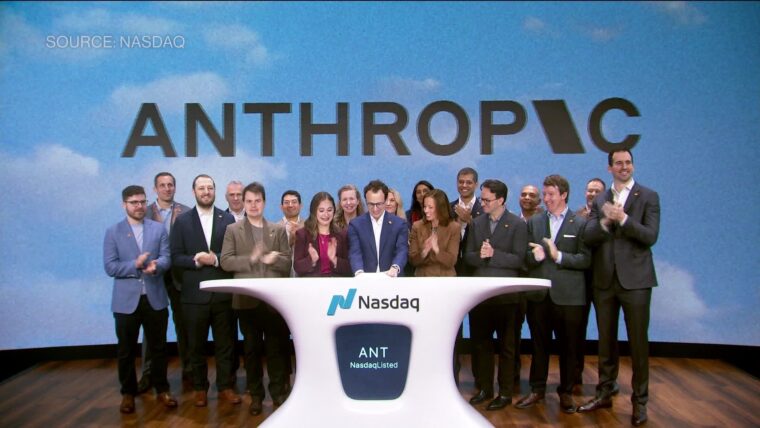
Anthropic’s executive team rang the opening bell at Nasdaq MarketSite in Times Square, with co-founders Dario and Daniela Amodei at the podium. Nasdaq’s own account posted the ceremony images to X (Nasdaq on X), and Anthropic’s listing-day video passed 3.7 million views with about 52,800 likes and 6,400 reposts by mid-afternoon (Anthropic on X). A text post of Dario Amodei’s full remarks had about 427,000 views (Anthropic on X). The single most-viewed market post we found, a one-line note from the account StockMKTNewz that Anthropic had just rung the opening bell, passed 1.3 million views (X).
The company kept its message on mission rather than money. “An obsession with safety and public benefit has been built into Anthropic’s DNA from the start,” Dario Amodei said before ringing the bell, in remarks posted by Yahoo Finance. Daniela Amodei framed the listing as a way to widen ownership: “A big part of why we’re going public is to have more people invested in building AI well,” she said in a clip shared by Nasdaq.
That framing matters for shareholders. Anthropic is a public benefit corporation, which means its board is required to balance shareholder returns against its stated mission. Gil Luria, head of technology research at D.A. Davidson, told CNN that Anthropic has been explicit that there will be cases where it chooses not to maximise shareholder value.
The wider industry reaction split along familiar lines. Dan Ives of Yorkville Ives & Co. called the deal an “A-plus success” and said it should help restore confidence that the AI growth thesis is not waning (CBS News). Sam Grelck, an equity strategy analyst at Truist Advisory Services, was more guarded, describing the reception as “another indication of investors’ appetite for the AI theme after what’s been a challenging few weeks.” The strategic investors who bought $26 billion of Class N shares at $83, a group that includes Google, Nvidia, Microsoft, AMD, Broadcom and Micron, closed the day with a paper gain of 17.1% on that stake. Amazon, an early backer, now holds a listed asset whose value its own shareholders never voted on, a point we examined in our report on Amazon’s Anthropic stake. The pricing week also moved the chip names; see our Micron (MU) outlook from the morning of the debut.
David Fetherstonhaugh, chief investment officer at VistaShares, summed up the two-way pull on the rest of the market: “We could see both play out, with some near-term selling pressure even as Anthropic’s fundraising helps finance the next wave of AI infrastructure investment,” he told CNN.
Data analysis: the $2 trillion headline versus the $1.27 trillion print
The most useful number from day one is not the closing price. It is the gap between the two market values in circulation, and it is where a lot of money was lost or made today.
The “$2 trillion” figure is a fully diluted value: it counts every share, option and convertible that could become stock, about 18.1 billion shares on our arithmetic from the $1.5 trillion value at $83. Nasdaq’s listing page uses shares outstanding, about 13.1 billion at the close by our calculation. On that basis ANT was worth about $1.27 trillion, not $2 trillion, even at its high.
That distinction decided one of the largest prediction-market contracts of the year. Polymarket’s “Anthropic IPO Closing Market Cap” event, with about $17.8 million traded on its upper brackets, resolves on the primary exchange’s official listing page (Polymarket). Two hours before the close, traders priced a 64% chance that the closing value landed between $1.25 trillion and $1.5 trillion, and only about 0.6% on $1.5 trillion to $1.75 trillion, despite the $2 trillion headlines. On Nasdaq’s share count, the $1.25 trillion line sat at about $95.52 a share. At the close, Nasdaq’s page showed about $1.27 trillion, inside the $1.25 trillion to $1.5 trillion bracket, which traders priced at 98% straight after the bell.
The second piece of data synthesis is the revenue multiple. Anthropic’s filing showed revenue of $4.73 billion in the first quarter of 2026, $11.56 billion in the second and $16.96 billion in the third. Annualise the third quarter and the run rate is about $67.8 billion. Divide the fully diluted value by that run rate and the multiple moved like this through the day:
Price pointANTFully diluted valueMultiple of Q3 run rate
IPO price$83.00$1.50 trillion22.1x
First trade$111.50$2.02 trillion29.7x
Intraday high$115.10$2.08 trillion30.7x
Close$97.17$1.76 trillion25.9x
Fully diluted values scale the reported $1.5 trillion at $83 in proportion to the share price. Run rate is third-quarter 2026 revenue multiplied by four. FinanceFeeds arithmetic.
The pattern is clear. The market paid up to about 31 times run-rate revenue in the opening minutes and settled near 26 times by the close. Growth is the variable that justifies any of these numbers, and it is slowing in percentage terms: revenue rose about 144% from the first quarter to the second, and about 47% from the second to the third. A 47% quarter is still extraordinary for a company of this size, but every forward price depends on how much of it survives into the fourth quarter.
For a higher ANT priceAgainst
Index inclusion: Russell 1000 as early as 11 December and the Nasdaq-100 from 21 December force passive buying into a 7.4% float.Lock-up tranches release more stock on days 27, 48, 62 and 76 after listing, before the founders’ 180-day window.
Underwriter research starts when the quiet period ends, typically 25 days after listing.Truist found more than half of the 32 largest IPOs fell at least 50% at some point in their first year.
Revenue grew 47% quarter on quarter in Q3, and operating losses narrowed sharply.About $900 billion of compute commitments, and a PBC board that can put mission ahead of returns.
Quick take: Ignore the $2 trillion headline. On Nasdaq’s count ANT closed at about $1.27 trillion, or 25.9 times run-rate revenue fully diluted.
Regulation and governance: the tension the market has not priced
Anthropic lists into a regulatory climate that is turning less friendly to the AI trade. CBS News noted that AI stocks have swung on concerns about the debt financing the data-centre build-out and the prospect of a Democratic-led crackdown on the sector after the midterms. Any federal rules on model safety, compute export controls or AI liability would land on Anthropic first and hardest, because it is now the only frontier lab whose share price reacts in real time.
The irony is that Anthropic has spent years asking for exactly that kind of oversight. Its PBC status and its public safety commitments are the reason some investors bought the deal, and the reason others fear the company will leave money on the table. Speaking at Nasdaq, Dario Amodei told the room that “the most difficult safety work lies ahead of us” (Yahoo Finance on X). For a listed company, that sentence is a disclosure as much as a mission statement: it tells shareholders that safety spending will not be cut to hit a quarterly number.
There is also a market-structure question regulators will watch. Index providers changed their rules this year to fast-track mega IPOs. Nasdaq’s fast entry rule, effective from 1 May 2026, tests a new listing at the close of its seventh trading day and announces the addition after the tenth, according to Bloomberg via Stock Analysis. FTSE Russell’s notice flagged a potential Russell 1000 inclusion on 11 December (FTSE Russell). Retirement savers in index funds will therefore buy ANT within weeks of its debut, at whatever price the market sets, a point protesters from the New York City Democratic Socialists made outside MarketSite this morning, according to CNN. If ANT trades sharply lower after inclusion, expect that criticism to reach Washington.
ANT price prediction: what happens next
Our pre-open levels were $104 above and $78 below. The stock blew through the upper level at the open and closed below it, which tells us the demand side was stronger than we expected but that the supply side, the day-one insider shares, was as heavy as we feared. Here are the new levels, with the reasoning behind each.
By 21 December 2026 (Nasdaq-100 entry):
Bull $115. A retest of the $115.10 day-one high. This needs the index calendar to do the work: Russell 1000 buying from 11 December, the first underwriter research after the 25-day quiet period around 14 December, and Nasdaq-100 inclusion on 21 December, all chasing a float of about 7.4%.
Base $100. The stock holds the $93 to $98 band it built this afternoon and drifts up as index demand absorbs the first lock-up tranche. Renaissance Capital’s Matthew Kennedy had pencilled in about $100 for the first day (CBS News).
Bear $83. A full round trip to the IPO price. That is where the underwriters’ 147 million share greenshoe becomes a support tool: below $83, the banks can buy stock in the market rather than exercise the option. It would take heavy insider selling into the day-27 tranche, or a broad AI sell-off, to get there.
By mid-May 2027 (first results as a listed company and the founders’ first unlock window):
Bull $143. Fourth-quarter revenue repeats the third quarter’s 47% growth and the market keeps today’s 25.9 times multiple. That lifts the price in line with the run rate.
Base $102. Growth halves to about 23% and the multiple falls back to the 22.1 times investors paid at $83. Revenue growth and multiple compression roughly cancel out.
Bear $57.55. Half the day-one high. That is the drawdown Truist found in more than half of the 32 largest IPOs at some point in their first year (CBS News). A first quarterly report showing a sharp growth slowdown would be the trigger.
The single number to watch is the fourth-quarter revenue figure in Anthropic’s first earnings report. Everything above is a multiple of it. Until then, the index calendar favours buyers through December, and the lock-up calendar favours sellers from late December into February. These are reference levels, not forecasts or investment advice, and newly listed stocks often move far beyond any range.
For the crypto angle on the same session, see our report on Brad Garlinghouse’s bet that crypto bounces after the Anthropic IPO, and for the deal mechanics, our preview of the $70 to $78 range and the $83 pricing.
FAQ: Anthropic (ANT) stock
What was Anthropic’s closing price on its first day?
Anthropic (ANT) closed its first Nasdaq session on 19 November 2026 at $97.17, up 17.1% from the $83 IPO price. The stock opened at $111.50, hit a high of $115.10 and a low of $92.72, according to Nasdaq data.
Is Anthropic worth $2 trillion?
Only on a fully diluted basis near the open. At the close, Anthropic was worth about $1.76 trillion fully diluted and about $1.27 trillion on Nasdaq’s listing page, which counts shares outstanding. Prediction markets such as Polymarket settle on the listing-page figure.
What is the ANT stock price prediction?
FinanceFeeds sets bull $115, base $100 and bear $83 for ANT by its expected Nasdaq-100 entry on 21 December 2026, and bull $143, base $102 and bear $57.55 by mid-May 2027. These are scenario levels tied to index buying, lock-up expiries and revenue growth, not investment advice.
When does the Anthropic lock-up expire?
Anthropic uses a staggered lock-up. About 316 million shares held by non-founder insiders could be sold from day one, with further tranches on days 27, 48, 62 and 76. Co-founders can sell up to 29% after 180 days or after first-quarter 2027 results; the largest holders stay locked for up to a year.
When will Anthropic join the Nasdaq-100?
Bloomberg reports that Anthropic is on track to join the Nasdaq-100 at the open on 21 December 2026 under Nasdaq’s fast entry rule. FTSE Russell has flagged a potential Russell 1000 inclusion on 11 December. Index funds tracking both benchmarks will need to buy ANT shares.
How much did Anthropic raise in its IPO?
Anthropic raised $81.3 billion by selling 980 million Class A shares at $83, the largest IPO on record by base deal size. Including a $26 billion private placement with Google, Nvidia, Microsoft and others, the total reached $107.3 billion, according to CNN.
This article is for information only and does not constitute investment advice.