
 By
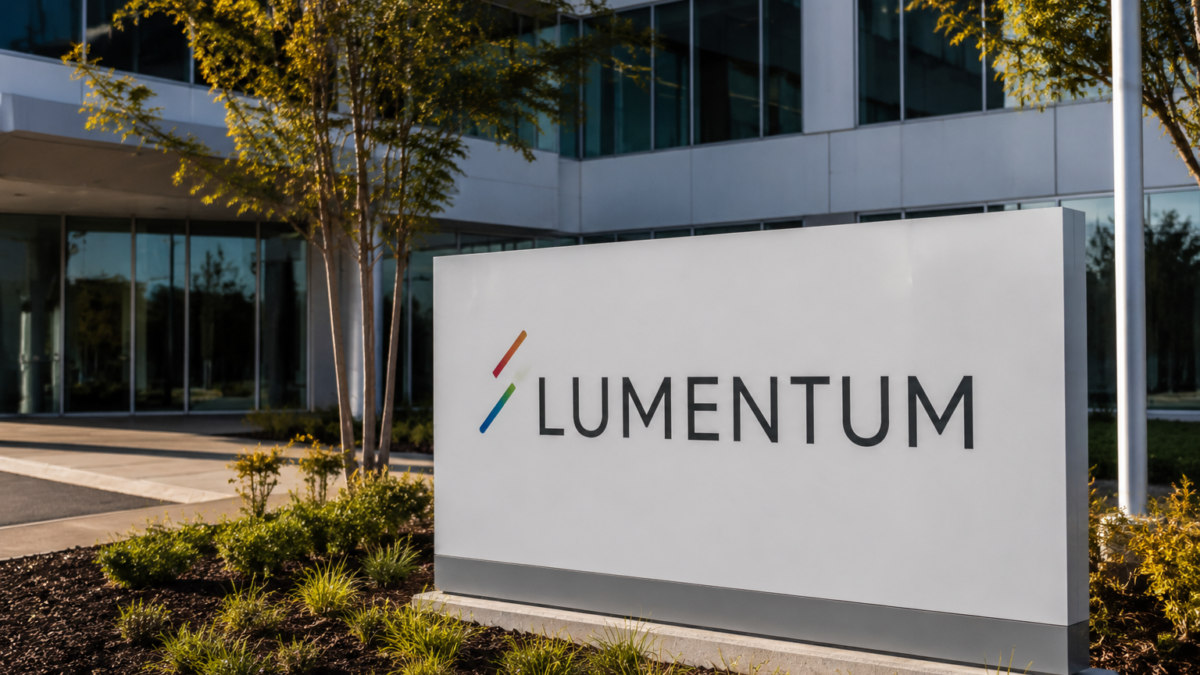
By Shares of Lumentum Holdings LITE rose 6% in pre-market trading on Friday after Chief Executive Officer Michael Hurlston said demand for the company’s optical components had exceeded available supply, with orders booked through early 2029.
The company is struggling to keep pace with demand from technology firms expanding artificial intelligence data centres.
Hurlston told Bloomberg News in an interview in Tokyo that Lumentum was unable to meet a significant portion of customer demand and was working to expand production capacity.
Lumentum orders sold out amid AI data centre demand
Hurlston said Lumentum’s optical components were “completely sold out” through early 2029, adding that customers were already beginning to secure orders for 2030.
The company cannot meet around 70% of demand for some products through next year and expects to fall short of 30% of demand for certain other products through 2028, he said.
Lumentum supplies advanced indium phosphide devices used in high-speed data transmission and cloud computing.
Its technology is becoming increasingly important as AI workloads require faster connections between servers, data centre racks and computing systems.
The company’s products include lasers that encode data onto light near chips, reducing the distance that high-speed electrical signals need to travel.
Optical connections can also reduce power consumption and heat generation compared with conventional copper-based interconnects.
Hurlston said the opportunity could expand significantly as optical technologies move closer to AI accelerators.
Demand for lasers in next-generation AI systems is expected to gain traction around 2029, he added.
Nvidia investment supports expansion plans
Lumentum received a $2 billion investment from Nvidia earlier this year, alongside a similar investment in rival Coherent.
The funding highlights the growing importance of optical technologies to AI infrastructure.
To meet demand, Lumentum has increased capacity at its Sagamihara facility in Japan twelvefold over the past two years.
The company plans to invest at least $350 million in the site and a neighbouring facility, with $75 million deployed so far. It has also expanded capacity at its plant in Caswell, England.
Hurlston said Lumentum was considering purchasing a facility in Japan and could seek subsidies to support further expansion.
The company may also need to consider an acquisition over the next year to broaden its product range.
However, increasing manufacturing capacity takes time.
Hurlston said building new production facilities typically requires three to five years.
He added that hyperscalers were willing to provide funding commitments that could help suppliers manage some of the risks associated with rapid expansion.
Optical stocks gain as AI infrastructure spending grows
Lumentum and other optical component makers have benefited from the broader AI infrastructure investment boom, although concerns about rising costs, debt and competition have made some investors more cautious.
The company’s shares have gained 171% year to date. Coherent shares have risen 55%, while Applied Optoelectronics has advanced 66%.
Analyst sentiment on Lumentum remains positive overall. According to TipRanks data, 14 of 18 analysts covering Lumentum rate it a Buy, while the remaining four rate it a Hold.
Supply constraints could also affect the sector if the US restricts new Chinese optical transceiver models.
Chinese manufacturers account for roughly two-thirds of global high-speed AI optical transceiver supply, according to Counterpoint Research.
Hurlston said the US would need to balance national security concerns against the risk of disrupting supply chains.
Meanwhile, Lumentum faces the challenge of expanding production quickly enough to serve customers as demand for AI infrastructure continues to grow.
The post Lumentum stock rises 6% as AI demand fills optical orders through 2029 appeared first on Invezz