
 By
By Arm Holdings closed at $322.90 on Monday, gaining 17.16% as Meta’s Muse assistant pushed investors back toward the central processors needed to coordinate agentic AI workloads. The move made Arm the Nasdaq-100’s leading gainer and extended a three-session advance from $243.98 on 16 September to 32.35%.The closing price matters because an intraday reading near $312 understated the final move. Arm traded as high as $324.16 and finished $47.29 above Friday’s close, with volume more than twice its recent daily average. The rally was part of a wider semiconductor move: Intel gained about 12%, AMD rose nearly 10% and passed $1 trillion in market value, while the Philadelphia semiconductor index added 4.3%.
Arm Added 32% Across Three Sessions
Arm began the sequence on Thursday after chief executive Rene Haas discussed confidence in its first Arm-designed data-centre processor. The rally accelerated on Monday as Muse remained at the top of Apple’s US App Store rankings.
The market read Meta’s early consumer traction as evidence that AI demand is moving beyond model training and chatbot prompts toward software agents that run multistep tasks. Those systems still depend on accelerators, but they also require CPUs to schedule work, call external tools, move data and keep the accelerator supplied.
That is the same thesis behind FinanceFeeds’ recent analysis of AMD’s move through a $1 trillion valuation. It also explains why Arm and Intel rose much more than Nvidia on Monday. The session rewarded the CPU layer of the AI stack rather than treating every semiconductor company alike.
Meta Is Arm’s Lead Partner on the AGI CPU
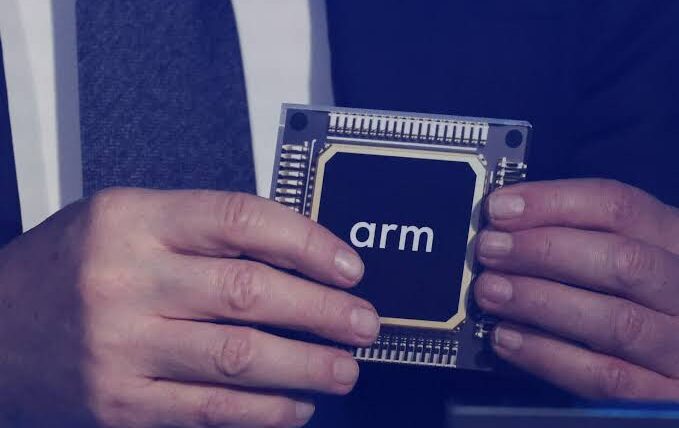
The link between Meta and Arm is direct, although Muse itself is not disclosed as running on the new processor. Arm launched the AGI CPU in March as its first production silicon product and identified Meta as its lead partner and co-developer.
Meta infrastructure head Santosh Janardhan said at the launch that the companies worked together on a processor intended to improve data-centre performance density and support a multigeneration roadmap. Meta plans to use the CPU alongside its own training and inference accelerator rather than as a substitute for accelerators.
That limits how far Monday’s move can be called Meta-specific. Meta provides technical validation and a deployment base, but Arm has also named OpenAI, SAP, Cloudflare, Cerebras and SK Telecom as customers or ecosystem participants.
The Meta relationship also predates Muse’s September launch. Monday’s catalyst was the market’s changed estimate of how quickly consumer agents could create infrastructure demand, not a new processor order disclosed by either company.
Arm Says Agent Workloads Need Four Times the CPU Capacity
Arm estimates that agent-driven data centres will require more than four times the current CPU capacity per gigawatt. Its investor presentation compares roughly 30 million CPU cores per gigawatt in an AI data centre with about 120 million in an agentic environment. Arm says agents generate more requests because they operate continuously and coordinate models, tools and data sources.
The figures are company estimates based on third-party research, customer feedback and management expectations as of March. They are not measured industry demand, and investors should treat the fourfold figure as Arm’s planning case.
The commercial pipeline is more concrete. Arm told shareholders in July that customer demand for the AGI CPU exceeded $2 billion across fiscal 2027 and 2028, up from a $1 billion opportunity disclosed previously. Initial products had been delivered to several customers, although manufacturing capacity remained a constraint.
FinanceFeeds examined this change in business model after Arm beat its guidance but lost 32%. Selling complete processors expands the addressable market but introduces manufacturing costs and lower margins than Arm’s established licensing and royalty business.
The Valuation Now Sits Above Wall Street’s Average Target
At $322.90, Arm trades above the average analyst target. StockAnalysis places the mean near $288.71, about 11% below Monday’s close, while MarketBeat calculates $305.72.
Bernstein analyst David Dai has argued that agentic computing could create a CPU renaissance, with the server CPU market growing from about $30 billion to $137 billion by 2030. Other firms have been more cautious. After Arm’s July results, published targets ranged from Goldman’s $150 to Evercore’s $326, illustrating how assumptions about AGI CPU sales, licensing growth and margins produce different outcomes.
The latest FinanceFeeds Arm valuation analysis sets out a $425 bull case and $150 bear case. Monday’s close already prices the shares well into that range, while remaining below the June record of $452.70.
What Could Reverse the Rally
The immediate risk is that Muse downloads do not translate into sustained usage, revenue or infrastructure orders. Amazon has reportedly blocked the agent from completing purchases on its platform, showing that agents can face access and security limits even when consumer demand is high.
Arm also has to convert demand into revenue while securing wafers, memory and packaging. Selling complete silicon creates execution risk and may dilute margins previously dominated by intellectual property.
After a 32% move in three sessions, the stock is also vulnerable to profit-taking or a reversal in the wider AI trade. Monday proved that Meta can revive the CPU thesis. It did not establish how much Muse will contribute to Arm’s orders or whether the current valuation has left room for delays.