
 By
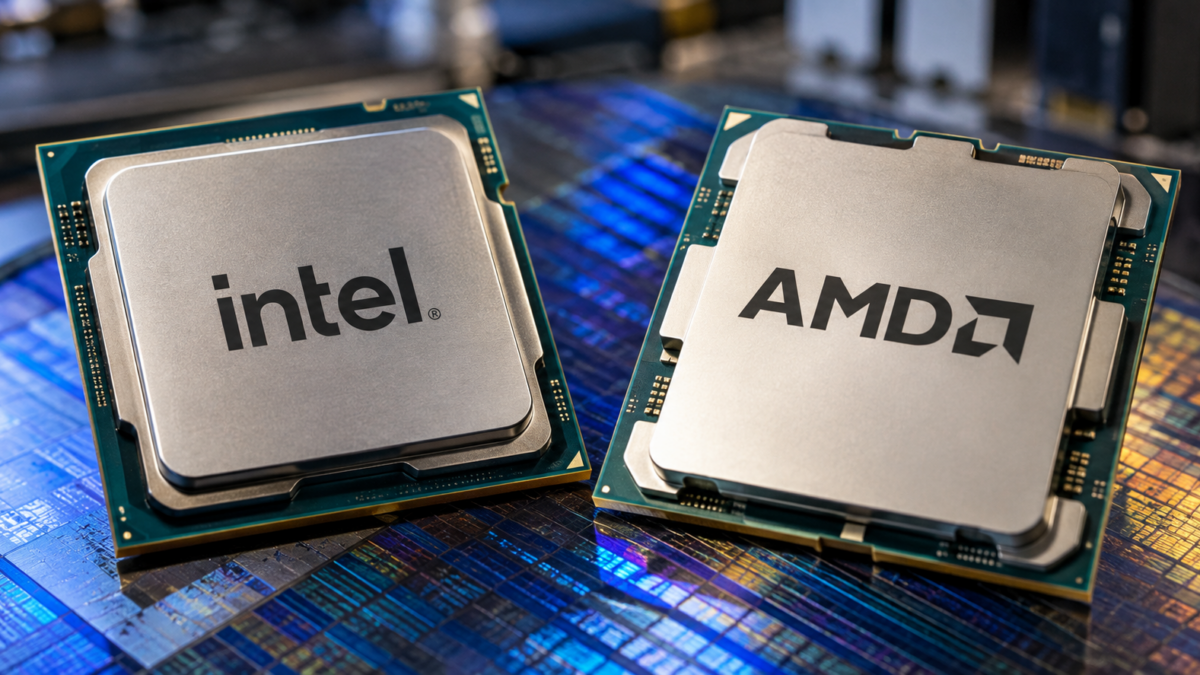
By Intel and AMD shares traded lower on Thursday as a broader selloff in US equities intensified, with surging oil prices and Treasury yields raising concerns about inflation and interest rates.
Intel stock INTC fell about 6%, while AMD declined over 4%.
The Philadelphia Semiconductor Index was down over 3.8%.
Brent crude futures jumped 4.2% to above $104 a barrel amid persistent concerns over Middle East supplies and disruptions to US production caused by a hurricane.
Meanwhile, the 10-year Treasury yield climbed to 5.3%, close to its highest level since 2002.
Higher oil prices can add to inflationary pressure and strengthen expectations for higher interest rates.
Rising bond yields can also weigh on high-growth technology companies because they increase the discount rate applied to future earnings.
Intel faces questions over Terafab and CPU share
Intel has also faced company-specific pressure this week after Elon Musk acknowledged that Taiwan Semiconductor Manufacturing Co. could potentially participate in his Texas-based Terafab chip project.
The comments contributed to a more than 5% decline in Intel shares across Monday and Tuesday.
However, Musk and Intel CEO Lip-Bu Tan subsequently sought to reassure investors about Intel’s role in the project.
Tan told Bloomberg ahead of an event in Tokyo that Intel’s involvement would continue.
Musk also responded on X to speculation that TSMC could take a larger role in the facility.
“No, we will build and run the fab. Let there be ZERO doubt about that. Maybe TSMC subleases part of the Terafab if they want, but nothing more than that,” Musk said.
AMD prepares for bigger AI chip demand
AMD, meanwhile, is preparing to substantially increase chip supply next year as it seeks to capitalize on growing demand for artificial intelligence infrastructure.
“We’ve been able to increase our supply as we’ve gone through 2026, and we’re going to substantially increase our supply in 2027,” CEO Lisa Su told reporters in Taipei.
AMD has been expanding its AI accelerator business as it competes with Nvidia, with the company’s market value recently surpassing $1 trillion.
The company could also benefit from rising demand for CPUs as AI workloads become more complex.
Agentic AI could boost CPU market
Meanwhile, earlier this week, Mizuho said the rise of agentic AI applications could significantly increase demand for CPUs, potentially benefiting chipmakers including AMD and Intel.
“We estimate agentic CPUs reaching ~$80B by 2030E (~123% 4Y CAGR), head-node CPUs to $68B (~61% 4Y CAGR), and traditional CPUs to $60B (~2% 4Y CAGR),” said Mizuho analysts, led by Vijay Rakesh, in an investor report.
“Total Server CPU TAM we estimate reaches ~$209B by 2030E (32% 4Y CAGR) and is conservatively below AMD’s AMD target of >$220B. Our bottom-up projection sees Agentic AI driving CPU, DRAM, and NAND growing to 22-30% of their respective total markets (number of bits shipped). Our model estimates Agentic AI CPU demand as a % of total server CPUs grows from ~4% today to ~30% by 2030E.”
The brokerage raised its price target on AMD to $705 from $580 and lifted its Intel target to $114 from $92.
It also raised targets on Dell, SanDisk and Super Micro Computer, maintaining an Outperform rating on all except Super Micro, which remained Neutral.
Mizuho identified four leading-edge processors for agentic AI workloads: Arm’s AGI CPU, AMD’s Venice, Nvidia’s Vera and Intel’s Diamond Rapids.
The outlook provides a longer-term counterweight to the immediate pressure facing semiconductor stocks.
The post Why are Intel and AMD stocks plunging on Thursday? appeared first on Invezz