
 By
By Artificial intelligence infrastructure is currently generating roughly three times as much profit per megawatt as Bitcoin mining for operators capable of serving both markets, according to new analysis from digital asset manager CoinShares.
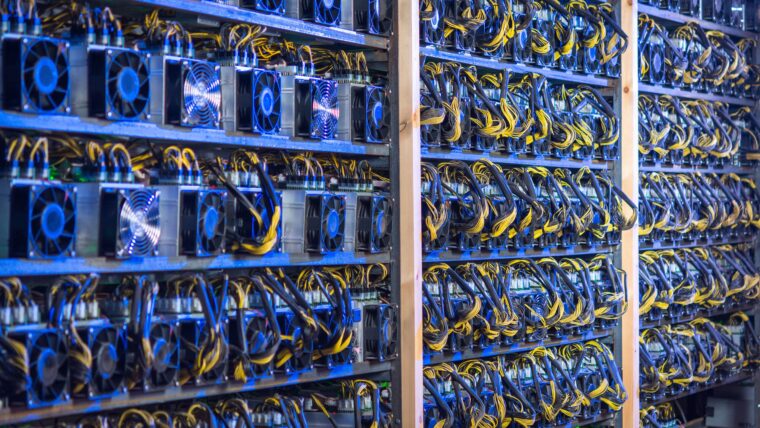
CoinShares estimates annualised profit from AI and high-performance computing, or HPC, at approximately $1.5 million per megawatt, compared with around $500,000 per MW from Bitcoin mining. The figures are estimates based on current industry economics rather than independently audited profitability measurements and can change materially with Bitcoin prices, mining difficulty, electricity costs and AI contract terms.The gap helps explain why several publicly listed Bitcoin miners are increasingly reallocating electricity, land and data-centre infrastructure toward AI workloads despite a recent recovery in Bitcoin prices.
Mining Economics Remain Under Pressure
Bitcoin miners faced particularly difficult economics during the second quarter of 2026. CoinShares said the average cash cost of producing one Bitcoin reached approximately $75,500, while BTC ended the quarter at around $58,400. Hash price — a measure of the revenue miners generate from a unit of computing power — fell to an all-time monthly low of about $27.70 per petahash per second per day in June. Bitcoin’s subsequent recovery toward $77,000 has lifted hash price to roughly $38 and returned most operators above cash breakeven, but CoinShares argues this improvement is unlikely to reverse existing AI commitments.
The economics are also structurally different. Building Bitcoin mining infrastructure typically costs around $700,000 to $1 million per MW, while AI infrastructure can require roughly $8 million to $15 million per MW because of higher-density computing hardware, cooling, networking and redundancy requirements. The much larger investment can nevertheless produce more stable, contracted revenue and materially higher margins once capacity is operational. CoinShares previously described HPC as potentially offering miners a “higher margin” revenue stream on a per-MW basis, while noting that AI data centres require significantly greater uptime and infrastructure sophistication than flexible Bitcoin mining sites.
Public Miners Accelerate Shift Toward AI
The transition is already reducing mining capacity. CoinShares estimates at least 35 EH/s of computing power is scheduled to leave publicly listed Bitcoin miners, equivalent to roughly 4.7% of the Bitcoin network’s current 750 EH/s hashrate. Keel, formerly Bitfarms, has already stopped Bitcoin mining, while IREN plans to complete its mining exit by the end of 2026. Cipher Digital is expected to move away from mining by the end of 2027, while TeraWulf is winding down approximately 145 MW of remaining mining capacity.
CoinShares’ earlier Q1 mining report showed how quickly the industry’s revenue mix was changing. It estimated listed miners could derive as much as 70% of their revenue from AI by the end of 2026, up from roughly 30%, with more than $70 billion of AI and HPC contracts announced across the public mining sector. The shift does not mean Bitcoin mining will disappear. Operators including Riot, MARA, HIVE and Bitdeer continue to preserve flexibility and could deploy additional mining capacity if Bitcoin economics improve substantially.
However, for miners that have already committed sites to long-term AI contracts, CoinShares expects the transition to be largely one-way. The combination of higher profit per megawatt and longer-term contracted revenues is turning electricity-rich Bitcoin miners into broader digital infrastructure companies — even when Bitcoin prices recover.