
 By
By Key Facts
Bitget’s updated institutional API rate-limit framework came into force on 3 September 2026.
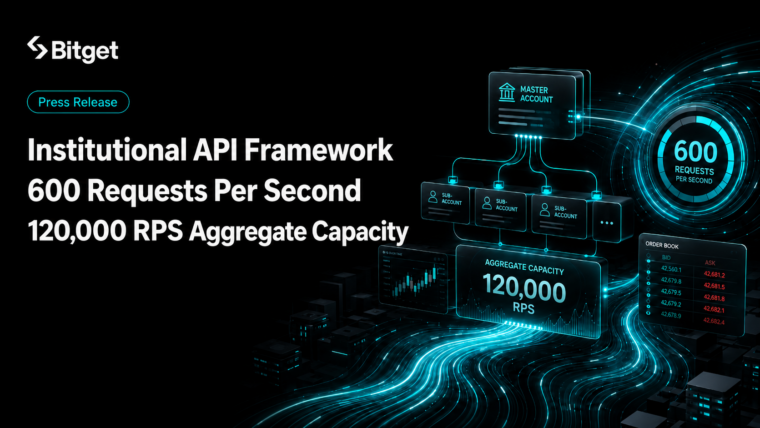
The top configurable single-account ceiling is now 600 requests per second per UID.
It applies only to top-tier market-maker (MM1) and PRO-tier (PRO6) clients on the unified trading account.
An aggregate master-sub-account cap of up to 120,000 RPS is quoted separately for UTA spot and UTA futures.
Limits are not applied automatically; unconfigured sub-accounts default to 10 requests per second.
Bitget’s updated institutional API rate-limit framework came into force on 3 September, raising the top configurable single-account ceiling to 600 requests per second per UID for eligible market-maker (MM1) and PRO-tier (PRO6) clients trading under the exchange’s unified trading account. The framework also introduces an aggregate master-sub-account rate-limit cap of up to 120,000 RPS, quoted separately for UTA spot and UTA futures trading.
The 600 RPS ceiling applies only to the top MM1 and PRO6 tiers. Other market-maker and PRO tiers receive correspondingly lower single-account and aggregate caps, and classic-account mode rate limits are unchanged.
Nothing is applied automatically
The maximum ceiling is not granted by default. Institutions must configure quotas per UID according to their trading strategy and account structure, and the combined allocation across sub-accounts cannot exceed the aggregate cap for that tier.
The fallback is the detail for any desk running this setup. Sub-accounts created after initialisation require manual rate-limit configuration, and where no quota is set, Bitget’s framework applies a default limit of 10 requests per second. The exchange advised eligible users to configure ahead of the effective date to avoid dropping to that floor — a 60-fold gap between ceiling and default is not one a quoting engine absorbs quietly.
Why rate limits matter for market makers
API rate limits determine how frequently an automated trading system can submit, cancel and replace orders, pull account data and manage execution workflow without being throttled. For market makers quoting across multiple instruments or operating several sub-accounts, a higher and more granular per-UID ceiling reduces the need to spread activity across additional accounts purely to gain request capacity. Bitget states the new structure lets institutions raise limits for a specific UID without opening new accounts.
It extends a track the exchange started in June 2025, when it launched its PRO Program for high-frequency and institutional traders, bundling lower fees, higher API frequency limits and increased withdrawal caps for firms meeting qualification thresholds. The tier structure named in this framework is the same one.
Execution layer, not custody
The update sits inside Bitget’s wider institutional stack, which covers unified trading accounts, whitelisted sub-account and API management, block trade and OTC — positioning the exchange at the execution layer of an institutional setup rather than as a custodian. Institutional users typically pair execution access at a venue with custody held through separate arrangements, a multi-provider structure common across the industry and one Bitget has supported directly by joining Copper’s ClearLoop network for off-exchange settlement.
Scope and configuration
The framework applies to MM and PRO users trading spot and futures through the unified trading account. Technical documentation covering API authentication, endpoint-level rate limits and unified-account integration is available in Bitget’s API documentation, while institutional account setup, including sub-account creation and API permissioning, is covered in its unified trading account guide. Institutional clients seeking PRO-tier access or help with API configuration can contact Bitget’s Institutional Partnerships team at institutional@bitget.com.
Frequently asked questions
Who qualifies for the 600 RPS ceiling?
Only top-tier market-maker (MM1) and PRO-tier (PRO6) clients trading under the unified trading account. Lower tiers receive proportionally smaller caps.
What happens if a sub-account is left unconfigured?
It falls back to the published default of 10 requests per second. Sub-accounts created after initialisation require manual configuration.
Does this change classic-account trading?
No. Classic-account mode rate limits are unchanged.
Founded in 2018 and registered in Seychelles, Bitget is a global cryptocurrency exchange positioned as a Universal Exchange (UEX), bringing crypto and a growing range of tokenised and traditional-market trading products into a unified platform. Its institutional offering includes unified trading accounts, sub-account and API management, PRO-tier services and institutional lending. Bitget has published monthly proof-of-reserves data since December 2022 and maintains a separate Protection Fund, a discretionary corporate reserve held apart from user deposits. Twitter | Telegram | LinkedIn | Discord