
 By
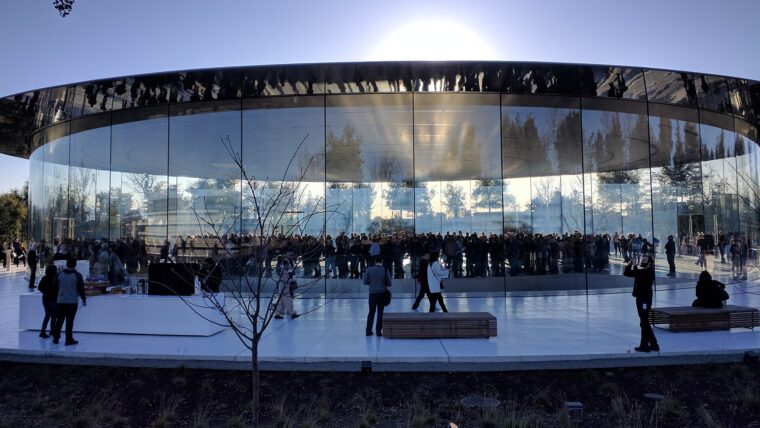
By The interesting thing about Apple’s next fortnight is not the foldable. On 1 September John Ternus becomes chief executive, ending the longest and most lucrative CEO tenure in corporate history, and on 9 September he walks onto the stage at the Steve Jobs Theater to launch a new product category. Apple closed 28 August at $319.70, a $4.67 trillion company that has gained 37.5% in twelve months. Yet the reallocation everyone expects the new CEO to make has already happened. In the nine months to 27 June 2026, Apple’s research and development spending rose 32.5% to $34.0 billion while share buybacks fell 12.0% to $62.1 billion. Tim Cook’s final act was to start dismantling the financial machine he is famous for building. Any Apple stock prediction that treats 9 September as the catalyst is looking at the wrong document.
Here is why that matters more than a hinge. For fifteen years the Apple equity case has been an algorithm: convert modest revenue growth into strong earnings-per-share growth by relentlessly shrinking the share count. That algorithm is what supports a multiple of 36.7 times earnings on a hardware company. A year ago Apple spent $2.75 buying its own stock for every $1 it spent on research. Today that ratio is $1.82. It has compressed by a third in twelve months, and it compressed under Cook, before the engineer took over. The bull case is that Apple is finally buying its way back into the AI conversation. The bear case is that the EPS algorithm justifying the multiple is being quietly retired. Both readings are supported by the same 10-Q.
Key facts: Apple in seven numbers
R&D up 32.5%, buybacks down 12.0% over the first nine months of FY2026 versus the same period a year earlier: $34.0bn against $25.7bn, and $62.1bn against $70.6bn. Source: Apple Inc. Form 10-Q, quarter ended 27 June 2026.
Q3 FY2026 revenue $109.4bn, up 16%, with iPhone revenue up 22% and gross margin of 50.06%, the strongest quarterly margin in the company’s recent history. Source: Apple Form 10-Q and Q3 results, 30 July 2026.
The stock still fell 7.35% on 31 July, its worst session of the past year, after Apple guided the current quarter on “supply constraints” despite beating on both lines. Sources: Apple Q3 results; StockAnalysis closes.
Consensus price target $324.45, just 1.49% above spot, across 44 analysts, with a range of $215 to $400. Strong Buy ratings have fallen from 25 in March to 19 in August. Source: S&P Global via StockAnalysis, 28 August 2026.
Apple trades at 36.7 times trailing and 34.9 times forward earnings, on free cash flow of $136.7bn and a shareholder yield of 2.46%. Source: StockAnalysis, 28 August 2026.
The foldable needs roughly $2,399 to hold Apple’s margin targets, according to Fubon Research, in a year when DRAM contract prices are up more than 75% and smartphone bills of materials are rising 5% to 7%. Source: Arthur Liao, Fubon Research.
Prediction markets put a foldable iPhone shipping before 2027 at 94.3% on more than $410,000 of volume, but price the whole of September as a coin flip: 50.0% that Apple touches $336, 49.5% that it touches $304. Source: Polymarket, 30 August 2026.
What the last quarter actually showed
Strip away the guidance and Apple’s operating performance is the best it has been in years. Over the first nine months of FY2026 revenue rose 16.2% to $364.4 billion, gross profit rose 21.7% to $178.8 billion and net income rose 20.0% to $101.5 billion. Gross margin expanded from 46.8% to 49.1% across the nine months and touched 50.06% in the June quarter. For a company that spent the early 2020s being described as ex-growth, a 16% revenue line with expanding margins is a genuine re-acceleration.
The market’s response on 31 July was to mark the stock down 7.35%, its worst day in twelve months, because Apple guided the September quarter on supply constraints. That reaction tells you what the stock is priced for. At 36.7 times earnings, a beat is the assumption and any friction is the news. We covered the mechanics of that session in our report on how Apple beat by every measure and fell 6% on two words.
Underneath, the composition of spending changed materially. R&D of $34.0 billion over nine months already exceeds Apple’s entire FY2025 research budget of $34.6 billion, and now runs at 9.3% of revenue. Buybacks fell for the first time in years. The share count still shrank, from 14.687 billion at 17 April to 14.594 billion at 17 July, but the rate of shrinkage is slowing. Apple did not announce a strategy change. It simply moved the money.
Why a hardware engineer changes the capital question
Cook’s Apple was an operations company. He came from supply chain, and his defining financial achievement was converting a maturing product business into an earnings compounder through scale, margin discipline and the largest buyback programme in history. Ternus is not that. He joined Apple in 2001, ran Hardware Engineering from 2021, and is the executive who ships silicon and enclosures.
Cook said as much in the succession announcement: “John Ternus has the mind of an engineer, the soul of an innovator, and the heart to lead with integrity.” Ternus’s own line was “I am profoundly grateful for this opportunity to carry Apple’s mission forward,” and Arthur Levinson, moving from non-executive chairman to lead independent director, described Cook’s tenure as having “transformed Apple into the world’s best company.”
Read those quotes as a capital-allocation signal rather than a press release. Engineers build. Apple has spent five days demonstrating exactly that, introducing the M6 and M5 Ultra on 25 August in a launch Apple framed around AI compute, a story that drew more than 1,300 points and 1,290 comments on Hacker News. Combine new silicon, an all-new Siri shipped at WWDC in June, and R&D running a third higher year on year, and the direction is unambiguous. Apple is spending. FinanceFeeds set out the strategic inheritance in our piece on how Ternus inherits Apple’s AI position.
The question is where the money comes from. Apple generates $136.7 billion of free cash flow a year and holds $39.5 billion of cash and equivalents. It cannot fund a hyperscaler-scale AI build and maintain a $90 billion annual buyback simultaneously. Something gives, and the nine-month figures show which one is already giving.
The margin problem hiding inside the foldable
The second pressure point arrives on 9 September. Apple is expected to launch the iPhone 18 Pro and Pro Max alongside its first foldable, widely reported as the iPhone Ultra, at the Steve Jobs Theater. Prediction markets put a foldable shipping before 2027 at 94.3%, so the product is close to a certainty. The economics are the open question.
Arthur Liao of Fubon Research models the foldable at about $2,399 and is explicit that this price is what the device needs “to cover the materials costs and hit Apple’s margins” rather than a premium land-grab. Liao notes DRAM contract prices up more than 75% against the fourth quarter of 2024 and total smartphone bills of materials rising 5% to 7% in 2026, with the foldable’s OLED panel, hinge and lightweight internals adding further cost. Ming-Chi Kuo’s range is $2,000 to $2,500.
That is the tension. Apple just posted a 50.06% gross margin, and the flagship product of its next cycle is priced to defend margin rather than expand it, in a component cycle that is running against it. Our reporting on TSMC raising chip prices by up to 10% covers the other half of that squeeze. A first-generation foldable at low volume and thin margin is a rounding error on a $466.8 billion revenue base in year one. It matters because it sets the cost trajectory for the category Apple has chosen as its next growth engine.
Apple’s share price to 28 August 2026 against the $375 bull and $235 bear cases, with the 31 July guidance drop marked, and the nine-month shift from buybacks into R&D. Sources: Apple Inc. Form 10-Q for the quarter ended 27 June 2026; daily closes via StockAnalysis.
The long-term case: one number times another
Apple’s valuation reduces to two variables, and the incoming CEO influences both. Forward earnings per share of roughly $9.20, and a multiple of 34.9 times. Everything else is commentary.
The bull case, and how we get to $375. The re-acceleration is real: revenue up 16.2%, net income up 20.0%, iPhone up 22% in the June quarter. If Apple carries that into FY2027, earnings per share reaches roughly $11.00. Hold today’s forward multiple of about 34 times, which the market has demonstrably been willing to pay, and the result is approximately $375. This requires no multiple expansion at all. It requires only that the foldable extends the iPhone cycle, that the new Siri closes enough of the AI gap to stop the narrative discount, and that Apple’s spending produces products rather than press releases. That sits below the Street high of $400 and comfortably above the $335 median.
The bear case, and how we get to $235. Earnings per share stalls at about $9.20 as buybacks keep shrinking, component costs bite and the foldable dilutes hardware margin. Then the multiple does the damage. If the market concludes that Apple is now a capital-intensive AI builder rather than a capital-returning compounder, 34.9 times is the wrong multiple; something nearer 25.5 times, close to Apple’s own longer-run median, is more defensible. That combination gives approximately $235. Note that this is not a catastrophe scenario. It assumes Apple’s revenue holds and only the market’s willingness to capitalise it changes. The Street’s own low target is $215, which is 33% below spot, so a $235 bear case is not an outlier view.
What the market actually expects. Polymarket’s September ladder for Apple is thin but continuously quoted, and it is remarkably symmetric: a 50.0% chance the stock touches $336 during the month against a 49.5% chance it touches $304, with only 8% on reaching $368 and 8% on falling to $256. A new chief executive and an entirely new product category, and the market is pricing a plus or minus 5% event with almost no tail. That is either complacency or a correct assessment that neither the handover nor the foldable changes the earnings power of an iPhone franchise this large. It is worth deciding which before 9 September rather than after.
The signal the sell side is sending
One number deserves more attention than it is getting. The consensus price target across 44 analysts is $324.45, which is 1.49% above where the stock trades. In practice Wall Street is saying Apple is worth roughly what it costs. That is unusual, and it is a marked change: Strong Buy ratings have fallen from 25 in March to 19 in August, Strong Sell ratings have risen from one to three, and total coverage has thinned from 48 analysts to 44.
This is the opposite of what we found when we ran the same exercise on Nvidia, Amazon and Tesla, where consensus targets sat well above spot. On Apple the Street has stopped underwriting further upside, at the exact moment the company is changing chief executive and entering a new product category. A stock priced at fair value by its own analyst base has no valuation cushion if execution disappoints, and no ceiling imposed by scepticism if it does not.
What happens next: three predictions
One: the foldable’s price is the real headline on 9 September. If the iPhone Ultra launches at or above $2,399, Apple is protecting margin and the bull case survives intact. If it launches materially below $2,000, Apple is buying category share at the expense of the 50% gross margin, and the market will treat that as a strategy change, not a bargain.
Two: the buyback line in the FY2026 fourth-quarter release is the number to read first. Nine-month repurchases are already down 12.0%. If the full-year figure lands below $80 billion while R&D exceeds $45 billion, the reallocation is confirmed as policy rather than timing, and the EPS algorithm that supports 36.7 times earnings needs re-underwriting. Apple reports FY2026 results in late October, and that is a bigger event for the multiple than the keynote.
Three: Ternus gets roughly two quarters of grace. New chief executives are judged on their first full product cycle, not their first keynote. The March 2027 window, when the standard iPhone 18, the 18e and the Air 2 are expected under Apple’s new staggered launch strategy, is when the market will form a view on whether the handover changed anything. Until then the stock trades on the same two variables it always has.
Tim Cook took over from Steve Jobs on 24 August 2011, and hands over almost exactly fifteen years later. He leaves a company with better growth than when the year started, a record gross margin, a shipped Siri, new silicon and a foldable on the launch pad. He also leaves it spending a third more on research and 12% less on its own stock, at a multiple built on the opposite behaviour. That is the inheritance, and it is a more interesting one than a hinge.
Frequently asked questions
When does John Ternus become Apple CEO?
1 September 2026. Apple announced on 20 April 2026 that Tim Cook would become executive chairman and John Ternus, previously senior vice president of Hardware Engineering, would become chief executive. Ternus joined Apple in 2001 and joins the board. Cook remains involved in certain areas, including engagement with policymakers. Ternus’s first keynote is the “Surprise and shine” event on 9 September.
What is Apple expected to launch on 9 September 2026?
The iPhone 18 Pro and iPhone 18 Pro Max, plus Apple’s first foldable, widely reported as the iPhone Ultra, alongside new Apple Watch models. Under a new staggered strategy the standard iPhone 18, the 18e and the iPhone Air 2 are expected around March 2027 rather than in September. Prediction markets put a foldable shipping before 2027 at 94.3%.
Is Apple stock overvalued in 2026?
By its own analyst base, roughly fairly valued. The consensus target across 44 analysts is $324.45 against a spot price of $319.70, an implied upside of 1.49%. Apple trades at 36.7 times trailing earnings and 34.9 times forward earnings. The bull argument is that 16.2% revenue growth justifies it; the bear argument is that the multiple was built on buybacks that are now shrinking.
Why did Apple stock fall on 31 July 2026?
Apple beat on both revenue and earnings for the June quarter, with revenue of $109.4 billion up 16% and iPhone revenue up 22%, then guided the following quarter citing “supply constraints.” The stock fell 7.35%, its worst session of the past twelve months. At a multiple in the mid-thirties, the beat was already priced and the guidance was not.
Is Apple behind on AI?
Less than it was. Apple shipped an all-new Siri at WWDC in June 2026 and introduced the M6 and M5 Ultra chips on 25 August in a launch framed explicitly around AI compute. Research and development spending is up 32.5% year on year over nine months. The open question is not effort but scale: Apple’s capital expenditure remains far below that of the hyperscalers it competes with on AI, and closing that gap would require money currently returned to shareholders.
What would move Apple to the $375 bull case?
Earnings per share reaching roughly $11.00 in FY2027 while the market holds today’s forward multiple of about 34 times. That needs the foldable to extend the iPhone replacement cycle, the new Siri to neutralise the AI-laggard discount, and gross margin to hold near 50% despite rising component costs. No multiple expansion is required, which is what makes it a credible rather than a heroic case.
This article is for information only and is not investment advice. The $375 bull case and $235 bear case are FinanceFeeds estimates derived from Apple’s own filings and published consensus data, not price targets. Prices are as of the 28 August 2026 close. Primary sources: Apple Inc. Form 10-Q for the quarter ended 27 June 2026; Apple Newsroom on the CEO transition; Apple Q3 FY2026 results; StockAnalysis consensus and valuation data.