
 By
By The comparison everyone is making is wrong in a specific, checkable way. Applied Optoelectronics (NASDAQ: AAOI) is being pitched across retail feeds as “the next SanDisk” because both charts look the same — a sleepy component supplier that woke up and went vertical. But SanDisk’s move was a margin event and AAOI’s is a volume event, and that distinction decides whether $235 or $95 is the right number. SanDisk ran roughly 78% gross margin in its fiscal third quarter of 2026 as NAND pricing went parabolic. Applied Optoelectronics posted 27.7% GAAP gross margin in the June quarter — down from 30.3% a year earlier — while revenue grew 86.4%. AAOI closed at $150.28 on 14 August 2026, 35.7% below its own 52-week high of $233.67. Growing fast at a flat, thin margin is a different business than selling a scarce commodity into a shortage, and it deserves a different multiple.
Here is the synthesis that the “next SanDisk” framing misses entirely. Both stocks did run: SanDisk travelled from $42.82 to $2,354.39 across its 52-week range, a 55-fold move, and AAOI from $18.50 to $233.67, a 12.6-fold move. But pull the income statements and the engines are opposites. SanDisk’s revenue and its margin rose together, because a memory shortage lets the seller reprice existing capacity — that is operating leverage in its purest form. AAOI’s revenue nearly doubled while gross margin contracted 255 basis points and the loss from operations widened from $15.98m to $24.73m. Applied Optoelectronics is not repricing scarce supply. It is buying revenue with capacity, and paying for that capacity with shareholder equity. That is the whole bull-bear argument, and almost nobody is stating it in those terms.
Key facts
Q2 2026 revenue: $191.9m, up 86.4% year over year — a fifth consecutive record quarter — (AAOI Form 10-Q, filed 6 August 2026)
GAAP gross margin: 27.7%, versus 30.3% in Q2 2025 and 29.1% in Q1 2026 — falling on both comparisons — (AAOI Q2 2026 results, 6 August 2026)
GAAP net loss: $22.8m, or $(0.28) per share, versus a $9.1m loss a year earlier — (AAOI Form 10-Q)
Diluted share count: 81.6m, up 43.7% from 56.8m a year earlier — (AAOI Form 10-Q)
Q3 2026 guidance assumes ~92.8m shares — a further 13.8% dilution in a single quarter — (AAOI business outlook, 6 August 2026)
Inventories: $278.8m, up 52.3% since 31 December 2025; receivables up 28.5% to $314.0m — (AAOI Form 10-Q)
Spot: $150.28 at the 14 August 2026 close, 35.7% below the 52-week high — (daily closes, stockanalysis.com)
What is actually happening at Applied Optoelectronics
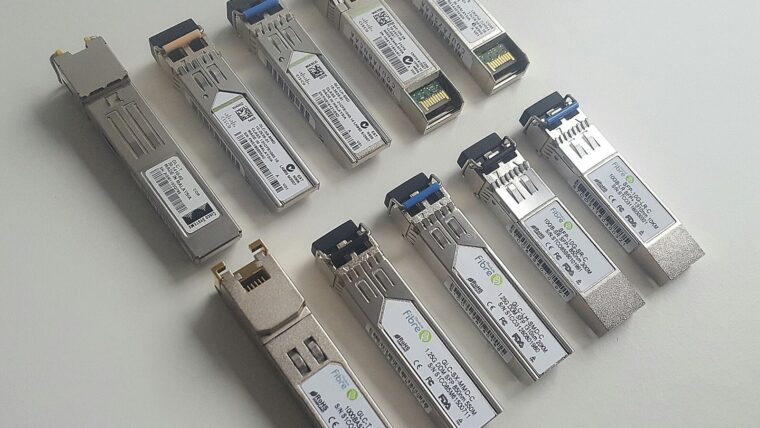
Applied Optoelectronics makes the optical transceivers that move data between racks inside a data centre. When an AI cluster outgrows the distance copper can carry a signal, the connection has to become light, and somebody has to make the module that converts it. That is AAOI’s business, and it has been a brutal one for most of the company’s history — a commodity supplier squeezed between hyperscale customers with enormous buying power and component costs it does not control.
The June quarter was genuinely good on the top line. Revenue of $191.9m beat consensus, data centre revenue reached $107.7m and crossed over to become 56.1% of the mix for the first time, and management said 800G product volume more than doubled sequentially. The legacy CATV business, which was the whole company not long ago, is now 42.0% of revenue and shrinking in relative terms. The third-quarter guide is aggressive: $255m to $290m, a midpoint 42% above the quarter just reported.
What did not improve is the part that matters for a 12-fold re-rating. Cost of goods sold rose from $71.8m to $138.7m, faster in percentage terms than the company’s ability to price. Operating expenses climbed to $77.9m against $47.1m. The result is that a business which grew revenue by $89m year over year converted none of it into operating profit — the operating loss got bigger. Guidance calls for non-GAAP gross margin of 29% to 30.5% in Q3, which is to say roughly where it was two years ago.
The gap between the headline and the filing is worth being precise about, because the headline everyone ran was “return to profitability.” That refers to non-GAAP net income of $5.5m, or $0.06 per diluted share. The GAAP figure in the same release is a net loss of $22.8m. Bridging those two numbers takes $28.3m of add-backs, and the company’s own reconciliation policy lists stock-based compensation, non-recurring expenses, amortisation of intangibles, unrealised FX, disposal losses and a non-GAAP tax adjustment among them. Neither number is dishonest. But an investor paying roughly 18 times trailing sales is paying for the first one.
Chief executive Dr. Thompson Lin framed the quarter this way in the results release: “Q2 was a pivotal quarter for AOI. We delivered record revenue for our fifth consecutive quarter and achieved an important milestone as we returned to non-GAAP profitability in the quarter. Further, we saw a strong volume ramp of our 800G products, which more than doubled sequentially.”
How the market and the analysts actually responded
The response has been unusually split, and the split is informative. Raymond James raised its target to $178 with an Outperform rating. B. Riley’s Dave Kang raised his to $109 but kept a Neutral rating — an analyst moving his number up while explicitly declining to recommend the shares. Consensus sits near $163. That is a wide band for a company this size, and wide analyst dispersion is generally a sign that the modelling assumptions, not the facts, are doing the work.
Retail sentiment is split even harder, and along platform lines. Aggregated sentiment trackers put X at roughly 66% bullish on AAOI against Reddit at about 13% — the same stock, the same week, near-opposite readings. That is not noise; it reflects two different holding periods looking at the same chart.
The sceptical case on Reddit is more sophisticated than the sentiment score suggests. In an r/investing thread arguing the shares are “trading at a price that is beyond reality,” one commenter made the cleanest version of the argument: “The high implied volatility is a sign the move is not based on fundamentals/long term fund positions.” Another described exiting semiconductor positions entirely “until I feel the bubble either pops, or the insanity of the hype dies down.” These are not people who dislike the company. They dislike the price.
On the demand side, the bulls have real numbers behind them. Industry work circulating this month puts total high-speed transceiver demand near 63 million units this year, close to triple the prior year, with McKinsey projecting that 800G manufacturing capacity falls 40% to 60% short of demand through 2027 and that 1.6T shortfalls persist into 2029. If that shortfall is real and AAOI holds its share of it, the revenue ramp has years to run. The question the bulls have not answered is why a multi-year shortage has not yet produced a single basis point of margin expansion.
Market impact: the SanDisk comparison, quantified
Set the two side by side and the “next SanDisk” thesis either survives or it does not.
MeasureSanDisk (SNDK)Applied Optoelectronics (AAOI)
52-week range$42.82 – $2,354.39$18.50 – $233.67
Low-to-high move55.0x12.6x
Recent gross margin~78% (fiscal Q3 2026)27.7% GAAP (Q2 2026)
Margin directionExpanding with priceContracting, −255bps YoY
Latest bottom line$6.90bn GAAP net income (fiscal Q4 2026)$(22.8)m GAAP net loss
What drives the moveCommodity pricing cycleUnit volume and capacity
SanDisk’s fiscal fourth quarter produced $8.97bn of revenue and $6.90bn of GAAP net income — a company converting the majority of revenue into profit because memory prices moved and its cost base did not. That is what a genuine shortage looks like on an income statement. AAOI’s shortage, if it is one, is showing up as a bigger factory and a longer receivables line, not as pricing power.
Two balance-sheet items deserve attention from anyone modelling the bull case. Inventories rose 52.3% in six months, to $278.8m, and receivables rose 28.5%, to $314.0m — both faster than the six-month revenue growth rate of 69%. That is defensible if you are pre-building for a guided 42% sequential ramp. It is also exactly what it looks like when a ramp slips. The company does have the balance sheet to absorb a slip: cash stood at $499.7m at 30 June, up from $206.1m at year-end.
The dilution, however, is the item that a price target cannot ignore. Diluted shares went from 56.8m to 81.6m year over year, and the Q3 guidance is calculated on roughly 92.8m shares. A shareholder from twelve months ago owns materially less of each incremental dollar of revenue than the revenue chart implies. When you see AAOI’s revenue compared to its market capitalisation, remember that the denominator has been moving too. For a comparable framing on how AI-infrastructure names get repriced on capacity rather than earnings, our CoreWeave analysis after its Q2 print covers the same tension.
The accounting and disclosure tension
There is no securities-law problem here, and it should not be implied that there is. AAOI’s non-GAAP presentation is conventional, its reconciliation is published, and its policy statement describes each adjustment. The tension is narrower and more interesting: the SEC’s guidance on non-GAAP measures requires that GAAP results be presented with equal or greater prominence, and a company can satisfy that rule perfectly while the market still transmits only the non-GAAP number onward.
That is what happened here. The release states plainly that GAAP gross margin was 27.7% and that the GAAP net loss was $22.8m. The coverage that followed largely reported a return to profitability and a $0.06 beat. The disclosure worked; the transmission did not. For an investor, the practical rule is that on any company whose non-GAAP and GAAP lines have opposite signs, the reconciliation table is the primary document and the press release headline is commentary.
The second, real disclosure question is customer concentration. AAOI’s data centre business sells into a small number of hyperscale buyers, and its guided ramp depends on those specific programmes landing on schedule. Concentration cuts both ways at speed: it delivered the 86% growth, and a single postponed qualification would move a quarter. This is a structural feature of the optical module industry rather than a criticism of AAOI. It is also why the same demand forecast can support both a $235 and a $95 outcome depending on the timing of two or three customer decisions.
What happens next: the $235 bull case and the $95 bear case
The bull case to $235 (+56%). This requires the Q3 guide to land at or above its midpoint and, critically, for gross margin to break above the 30.5% guided ceiling in Q4 as 800G and 1.6T mix rises. If the McKinsey shortfall through 2027 is real, the first quarter in which AAOI prints a gross margin above 33% is the quarter the SanDisk comparison stops being lazy and starts being right. At that point a re-test of the 52-week high is straightforward, and the shares would be pricing a genuine pricing cycle rather than a volume ramp. Note honestly that $235 sits above the highest published analyst target we could verify — this is a scenario, not a consensus.
The bear case to $95 (−37%). This does not require the AI story to break. It requires only that margins stay near 30% while the share count keeps climbing toward and past 92.8m. On that path, revenue can grow 40% a quarter and the equity still de-rates, because the market eventually prices the business as a high-growth contract manufacturer rather than a shortage beneficiary. A round-trip to the early-August level near $110, then through B. Riley’s $109 Neutral target, gets to $95 without any operational disaster at all. The trigger to watch is a single quarter of sequential revenue growth accompanied by flat or lower gross margin.
The decisive datapoint arrives with the Q3 report. Revenue will almost certainly be a record; it is guided to be. Ignore it. The number that matters is gross margin, and the specific question is whether it printed above 30.5%. Everything else is already in the price.
Frequently asked questions
Is AAOI the same ticker as AAOL?
No. AAOL is a legacy symbol format for Applied Optoelectronics used on some terminals; the company trades on NASDAQ as AAOI. There is no separately listed security under AAOL.
Did Applied Optoelectronics make a profit in Q2 2026?
On a non-GAAP basis, yes — $5.5m, or $0.06 per diluted share. On a GAAP basis, no: the company reported a net loss of $22.8m, or $(0.28) per share. Both figures appear in the same 6 August 2026 release.
Why does gross margin matter more than revenue growth here?
Because the entire “next SanDisk” thesis assumes a shortage that lets the supplier raise prices. A shortage that raises prices shows up as margin expansion. AAOI’s margin fell 255 basis points year over year while revenue rose 86%, which is the signature of a volume ramp rather than a pricing cycle.
How much has AAOI diluted shareholders?
Diluted shares outstanding rose 43.7% year over year, from 56.8m to 81.6m. Third-quarter guidance is calculated on approximately 92.8m shares, implying a further 13.8% increase in a single quarter.
What are analysts targeting on AAOI?
The published range is wide. Raymond James carries $178 with an Outperform rating; B. Riley raised its target to $109 while keeping a Neutral rating. Consensus sits near $163 against a $150.28 spot price.
What would prove the bull case right?
A quarter in which gross margin breaks decisively above the 30.5% guided ceiling while revenue holds its ramp. That combination would demonstrate pricing power rather than capacity purchase, and would justify the comparison to a memory-cycle name.
Related reading on FinanceFeeds: our SanDisk SNDK bull and bear case sets out the memory-cycle comparison in full, the Fermi “next SanDisk” analysis applies the same test to a different candidate, and our Nokia price prediction covers the optical networking incumbent AAOI competes against. See also the Nebius case for AI infrastructure re-rating.
Sources: Applied Optoelectronics Form 10-Q for the quarter ended 30 June 2026 and Q2 2026 results release, both filed with the SEC on 6 August 2026; Sandisk fiscal Q4 2026 results; price data from stockanalysis.com as at the 14 August 2026 close.
This article is analysis, not investment advice. The bull and bear figures are scenarios constructed from published filings and guidance, not price targets or recommendations. Applied Optoelectronics is a high-volatility security and readers should conduct their own research.